

Welcome to visit our booth #1826 Level floor: Piso 1 at Latin Tyre & Auto Parts Expo in Panama.
#alloywheels #forgedwheels #wheels
¡Visítanos en el stand #1826, Piso 1 en la Latin Tyre & Auto Parts Expo en Panamá!
Ruedas de aleación y forjadas de alta calidad para tu negocio.
Te esperamos.
Introducing our expert sales team! We specialize in high-quality automotive products, including timing chain kits, rubber parts, and suspension components. Count on us for exceptional service and top-notch solutions. Trust us for reliable performance and durability. Let’s drive together!

Within the gaze, a warm sun’s embrace, In the heart, dreams dance and chase.


Two professional teams are here at booth 6.1 F15-16

On this International Women’s Day, let’s celebrate the achievements of all the women who have made significant contributions to the auto parts industry. We can also take this opportunity to encourage more women to pursue careers in this field and drive innovation forward.


By NBMOTOR Marketing
A shock absorber is easy to identify from the outside, but its real value is determined by what happens inside: hydraulic flow, valve response, sealing stability, heat management and repeatable manufacturing. For automotive aftermarket professionals, understanding these factors is essential when evaluating a replacement product, diagnosing a complaint or discussing specifications with a supplier.
This guide explains how automotive shock absorbers work, how the main designs differ, which manufacturing steps influence performance and which quality checks matter before a unit reaches the vehicle.
The suspension spring supports the vehicle and allows the wheel to move over road inputs. Left uncontrolled, however, the spring would continue to oscillate after each bump. The shock absorber—also called a damper—controls that motion.
As the piston rod moves, hydraulic oil is forced through carefully calibrated valve passages. The restriction creates a force that opposes suspension movement. Mechanical motion is converted into heat, which is then dissipated through the oil and outer body.
A correctly matched damper therefore contributes to:
A shock absorber does not carry out these functions in isolation. Tires, springs, bushings, mounts, wheel alignment and vehicle load all influence the final result.
Replacement dampers are supplied in several physical configurations. The correct format depends on the original suspension design:
These external forms should not be confused with the internal hydraulic architecture. The two most common internal layouts are twin-tube and monotube.
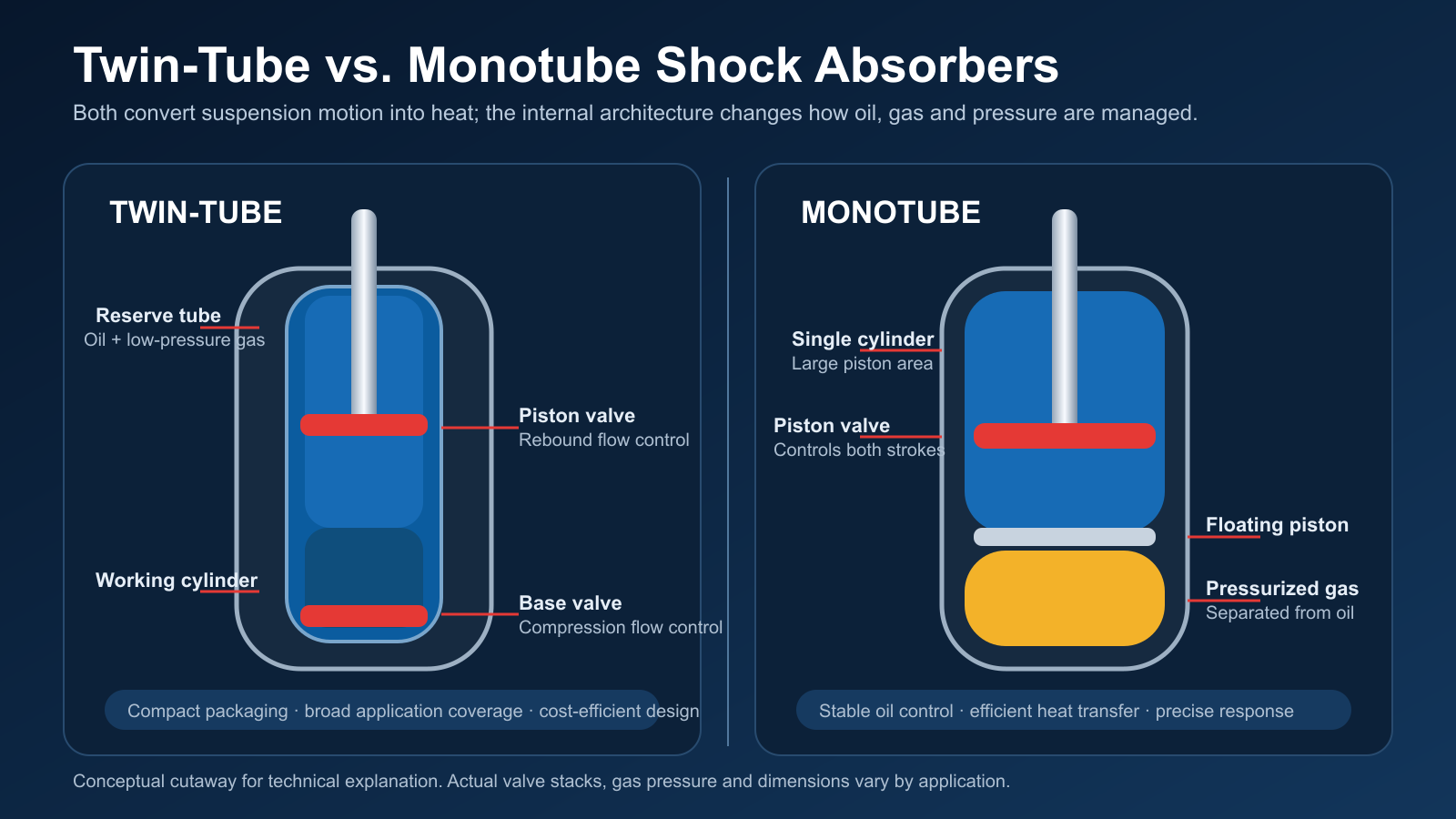
Conceptual cutaway. Actual dimensions, valve stacks and gas pressure vary by application.
A twin-tube damper uses an inner working cylinder and an outer reserve tube. The piston valve moves inside the working cylinder, while a base valve manages fluid exchange between the inner and outer chambers.
During compression, the entering piston rod displaces oil. Part of the oil flows through the piston valve and part passes through the base valve into the reserve chamber. During rebound, the piston valve provides the principal flow restriction while the base valve returns oil from the reserve chamber.
Twin-tube construction offers efficient packaging and broad application coverage. Its performance depends heavily on valve calibration, internal cleanliness, oil volume, gas control and assembly consistency.
A monotube damper uses a single pressure cylinder. The damping piston separates the working chambers, and a floating piston separates hydraulic oil from a pressurized gas chamber.
Because the oil and gas are physically separated, a properly designed monotube unit can maintain stable oil control under demanding operation. The larger working piston and direct contact between the cylinder and surrounding air can also support precise response and heat transfer. Packaging, ride targets, impact resistance, installation position and cost still need to be considered for each vehicle.
Neither architecture is automatically “better” for every application. The decisive question is whether the complete damper is correctly designed, manufactured and validated for the intended vehicle.
A damper operates in two directions:
The required force is not constant. It changes with piston speed and is shaped by bleed passages, orifices, discs, springs and valve geometry. Low-speed damping influences gradual body motions such as roll, pitch and weight transfer. Higher piston speeds occur during sharper road inputs and require adequate control without creating excessive harshness.
Manufacturers verify this behavior on a shock dynamometer. The resulting force-displacement and force-velocity curves reveal compression and rebound force, symmetry, hysteresis and consistency. Test velocities and temperature conditions must follow the drawing or customer specification; values from one application should not be copied to another.
Several parts have a disproportionate influence on service life and noise:
Shock absorber quality cannot be added only at final inspection. It is built through controlled component preparation and assembly.
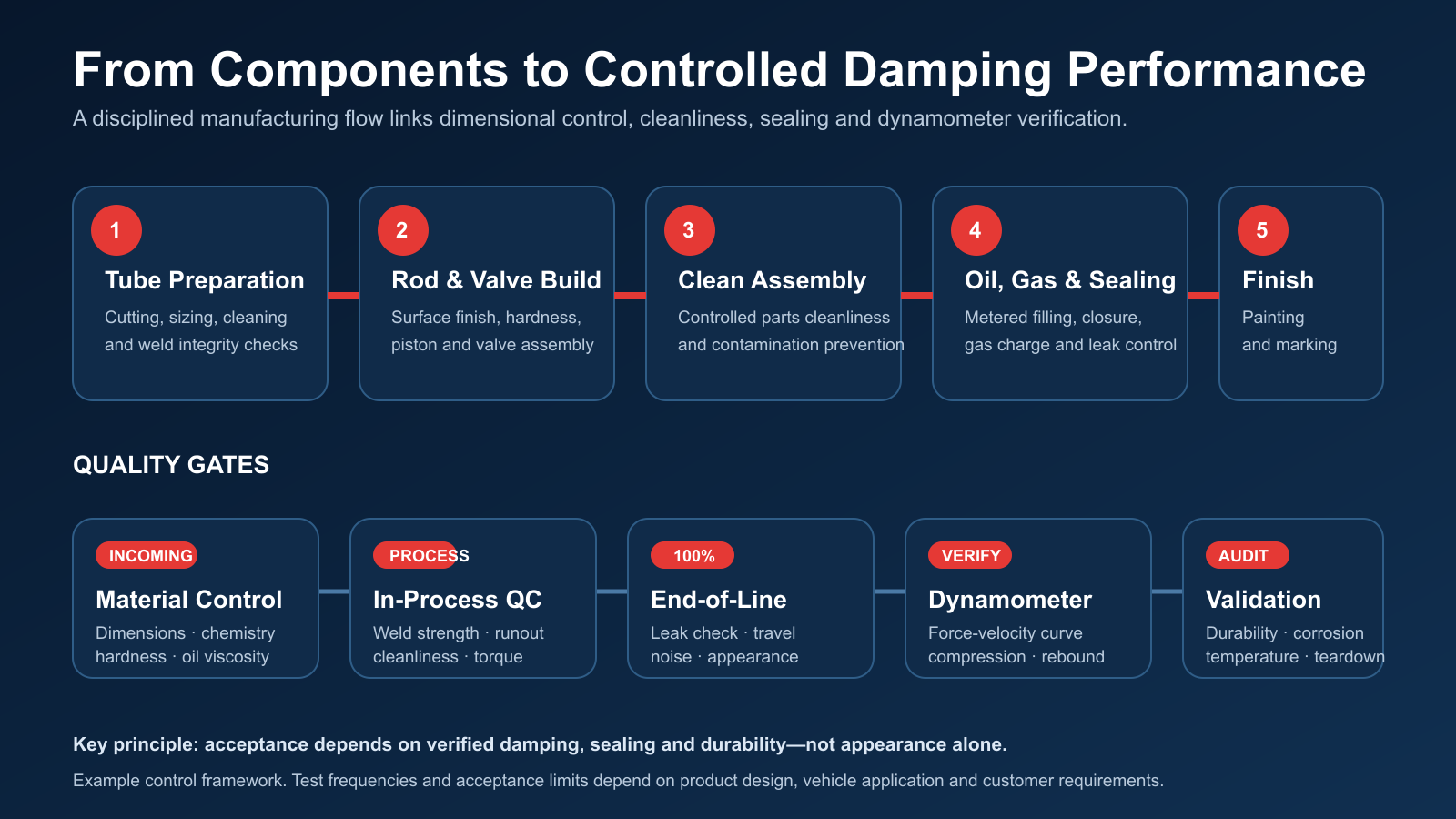
A typical production route includes tube cutting and sizing, welding, cleaning, piston-rod preparation, valve assembly, oil filling, gas charging, sealing, painting and final identification. The exact sequence varies by design, but five process controls remain especially important:
A robust inspection plan combines incoming checks, in-process control, end-of-line verification and periodic validation. Depending on the design and customer requirement, it may include:
Acceptance limits should always come from the approved product specification. A single force value, leakage limit or durability cycle count is not universal across passenger cars, commercial vehicles, performance applications and different damper architectures.
| Observed symptom | Possible damper-related causes | Other systems to inspect |
|---|---|---|
| Visible oil leakage | Seal damage, rod corrosion, guide wear, contamination or abnormal side load | Mounting alignment, damaged boot, impact damage |
| Excessive bouncing | Reduced damping force, internal valve damage, aeration or loss of oil/gas | Spring condition, tire pressure, vehicle load |
| Knocking or rattling | Internal looseness, worn guide, incorrect travel or damaged mounts | Top mount, bushings, stabilizer links, ball joints |
| Harsh ride | Excessive damping, high friction, incorrect application or binding | Tire specification, spring rate, bump stops |
| Uneven tire wear or instability | Weak or inconsistent damping may contribute | Alignment, tires, steering joints, bushings and wheel balance |
A light film around the seal area is not always equivalent to an active leak, and a ride complaint should never be diagnosed from the damper alone. Inspect both sides of the axle, verify mounting hardware and compare the vehicle condition with the service information for that application.
For distributors, workshops and private-label customers, a useful product review should go beyond catalog fitment. Confirm:
Always install with the correct tools and tightening procedure. On strut applications, spring compression work requires appropriate equipment and trained personnel. Where service instructions require axle-pair replacement, wheel alignment or new single-use fasteners, those requirements should be followed.
Technical requirements evolve. In China, QC/T 491-2018, Performance Requirements and Bench Test Methods for Automobile Shock Absorbers, replaced the earlier QC/T 491-1999 and QC/T 545-1999 documents and has been effective since January 1, 2019. For export programs, the applicable customer drawing, contractual specification and destination-market requirements must also be reviewed.
The practical conclusion is simple: a shock absorber is a calibrated safety-related chassis component. Reliable aftermarket performance comes from correct application engineering, clean and repeatable manufacturing, verified damping curves, sealing integrity and durability evidence—not from appearance alone.
NBMOTOR Marketing
Technical references: State Administration for Market Regulation: QC/T 491-2018; KYB technical information on monotube construction; KYB service information on shock and strut wear. This article is intended for general technical education. Product specifications and service procedures must be confirmed for each vehicle application.
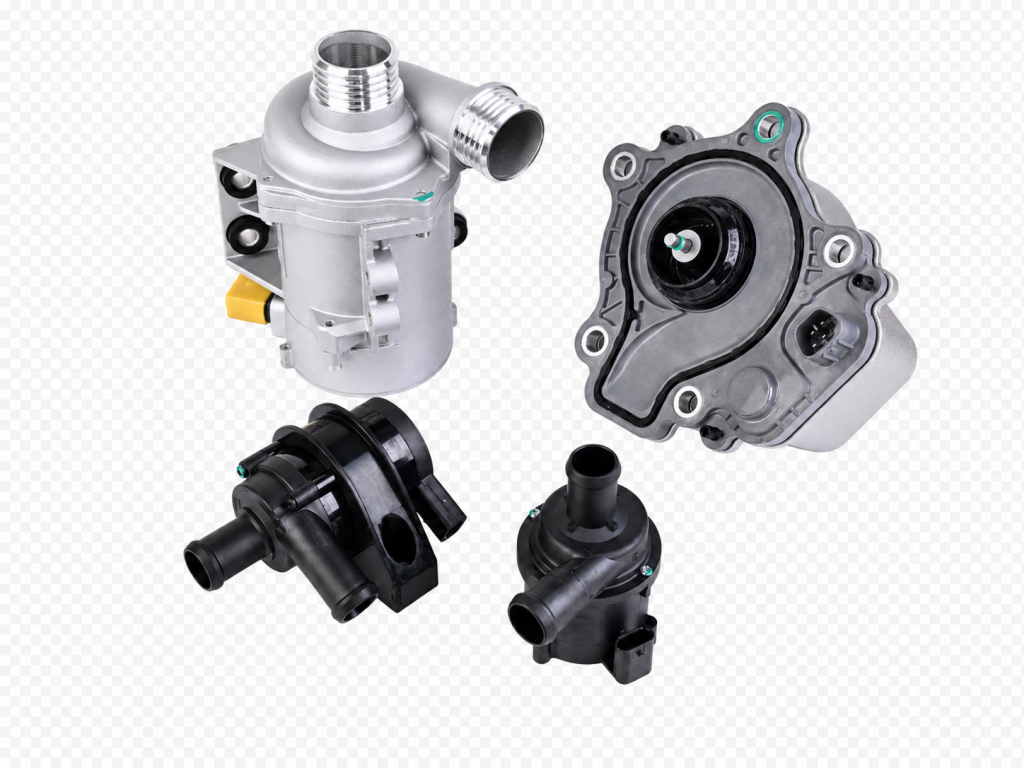
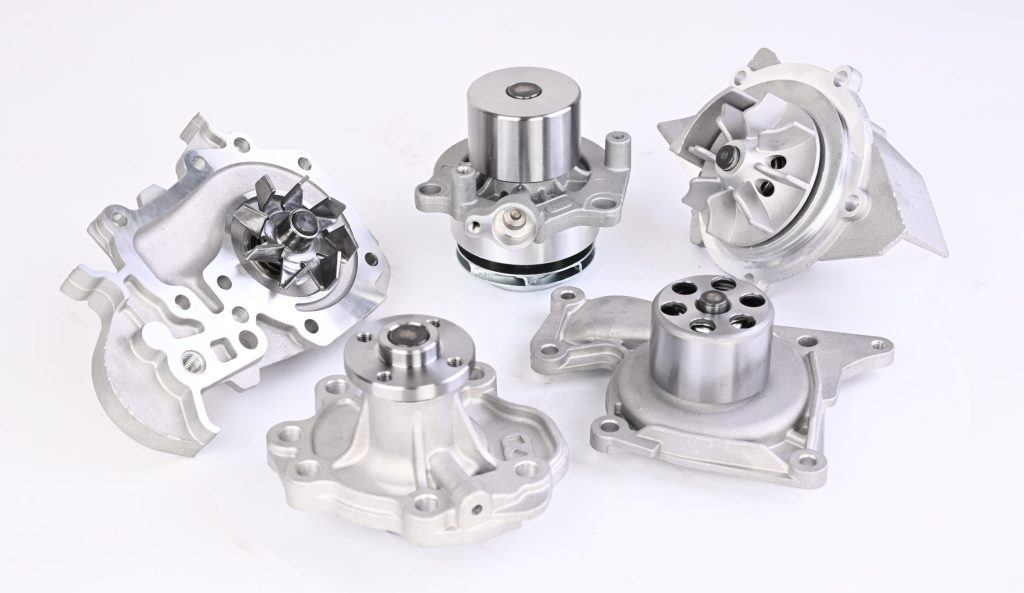
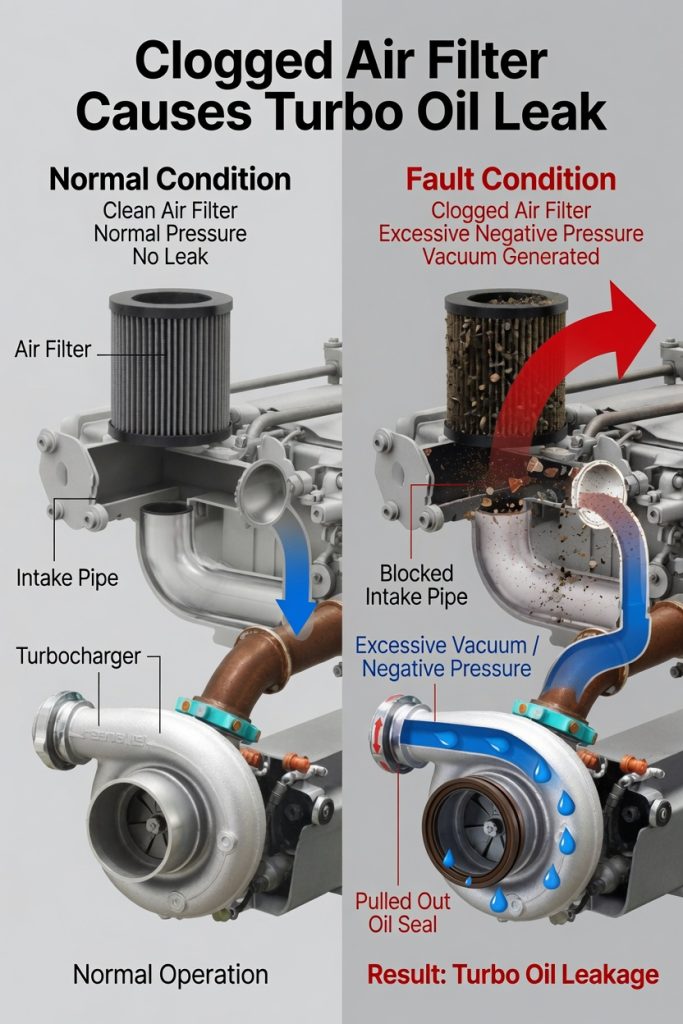
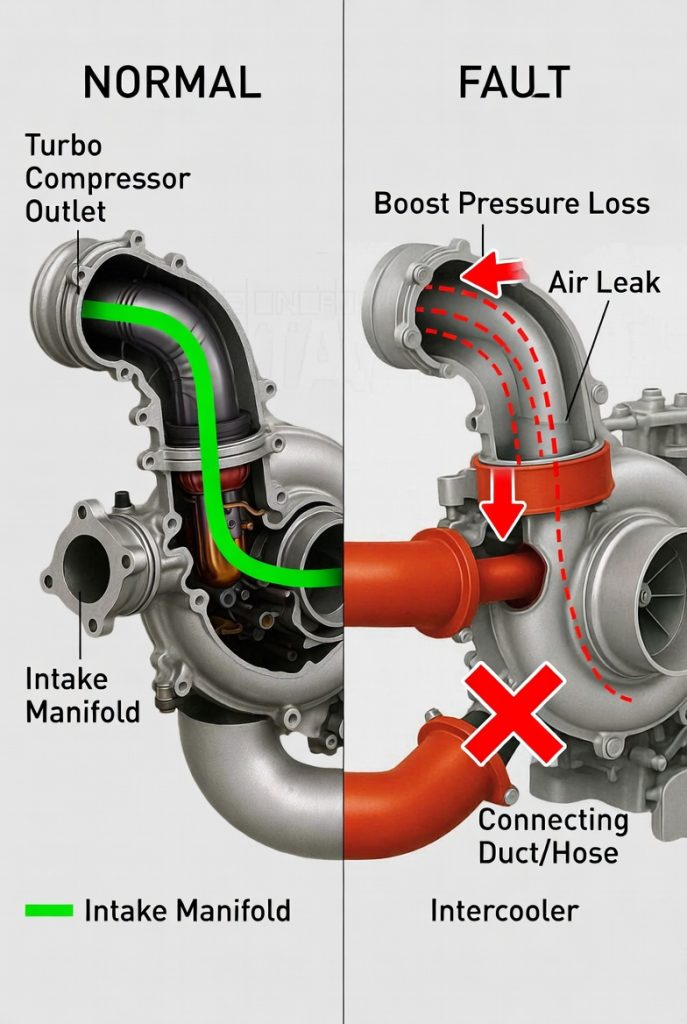
Oil leakage is one of the most common issues with turbochargers. Accurate diagnosis and timely correction can effectively
prevent premature turbocharger failure and significantly reduce unnecessary warranty returns.The following conditions are the primary causes of turbocharger oil leakage:
Important Notes for Distributors:
Event by Ningbo Motor Industrial Co-Factory Direct Steering&Suspensino/Engine parts– China & Global Suppliers
May 14, 2026, 7:00 AM – May 16, 2026, 3:00 PM (your local time)
Melbourne Convention and Exhibition Centre (MCEC), 1 Convention Centre Pl, Melbourne, Victoria, AU, 3006
Hall 4 Booth Q50J

The Zumbo wheels team leader of design and manufacturer of alloy wheels is attending Automechanika Dubai, come to say Hi.

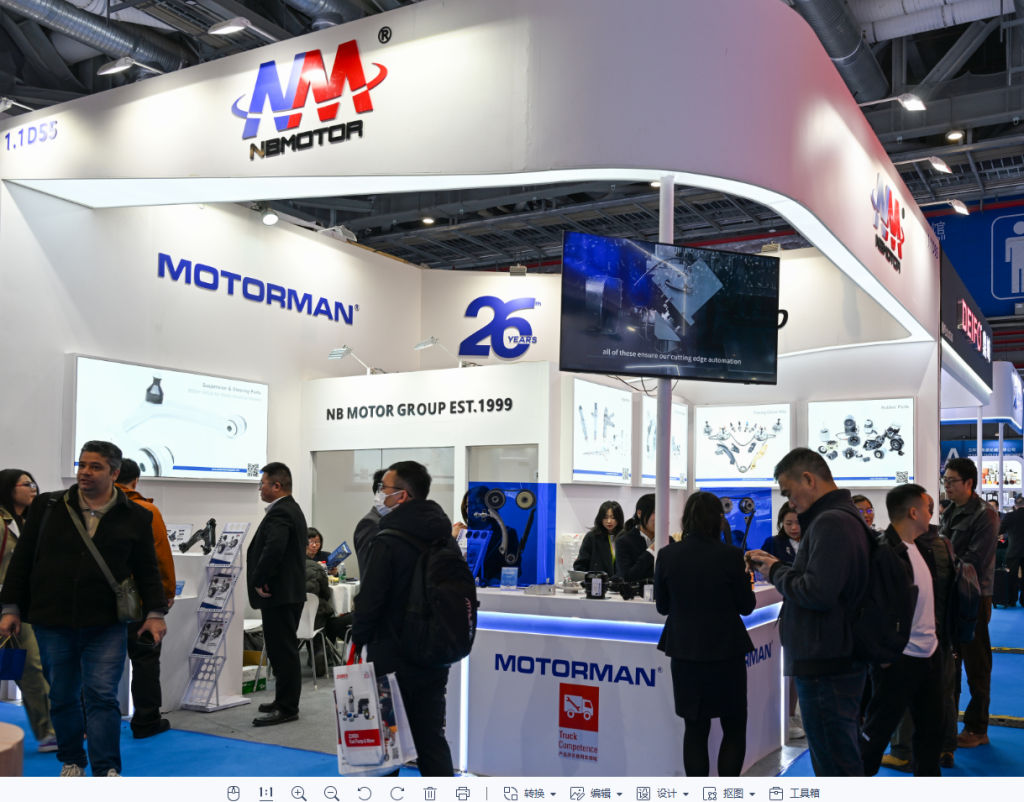
Thank you for joining us and visiting us at #AutomechanikaShanghai 2025. See you all next year! #autoparts
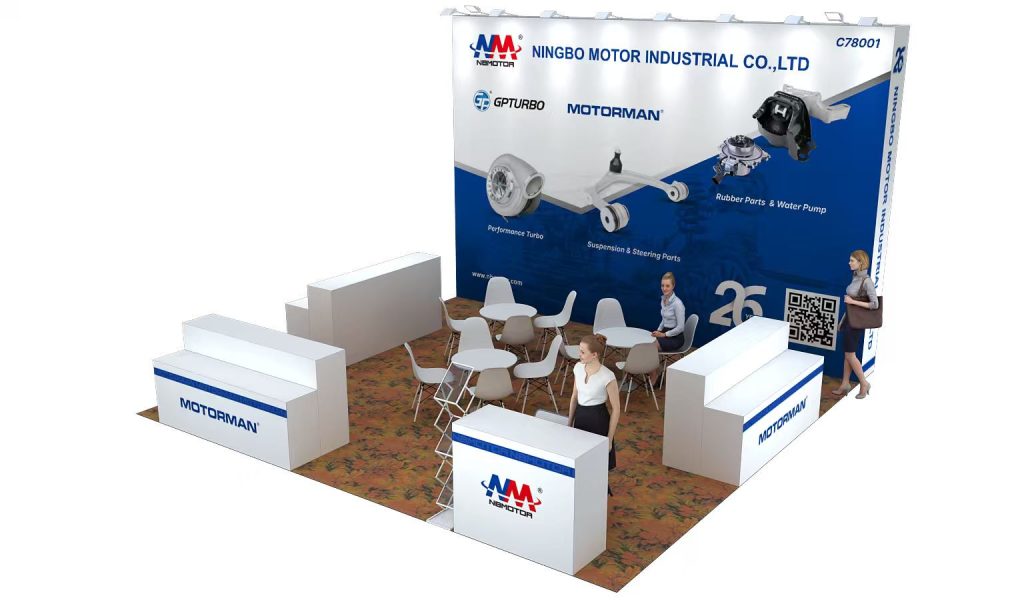
Heading to AAPEX 2025?
Stop by and connect with the NB Motor team in booth C78001. We would love to discuss everything that NB Motor has to offer and what sets us apart from the competition.

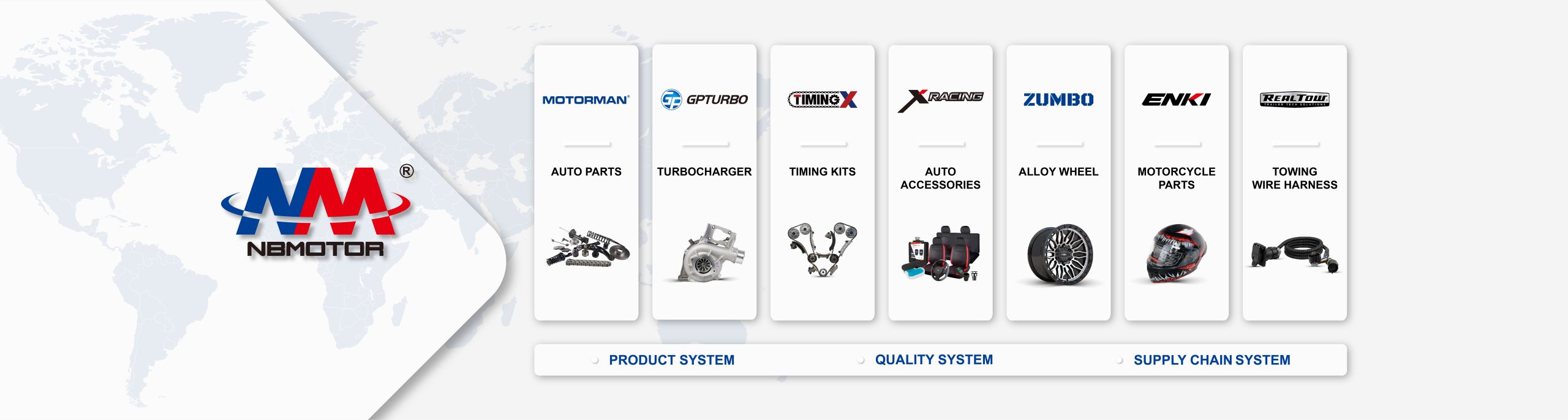
Ningbo Motor Auto Parts, alongside Motorman Auto Parts, Magic Car Parts (timing chain kits), GP Turbo, Zumbo Alloy Wheels, and Xracing Car Accessories, held a team-building event yesterday. The gathering provided a joyful and enriching experience, fostering stronger camaraderie and renewing our collective energy to enhance collaboration and productivity in the workplace.
Wishing you a smooth and successful return to work after the Chinese New Year holiday!
Still remember the days of the Automechanika Shanghai show and other trading shows we have attended in 2024, and our booth featuring timing chain kits, steering and chassis parts, turbochargers, alloy wheels and and car accessories is buzzing with activity!
We have more shows to attend in 2025. Thanks for the support from our customers-distributors, wholesalers and national retailers. See you all in 2025.

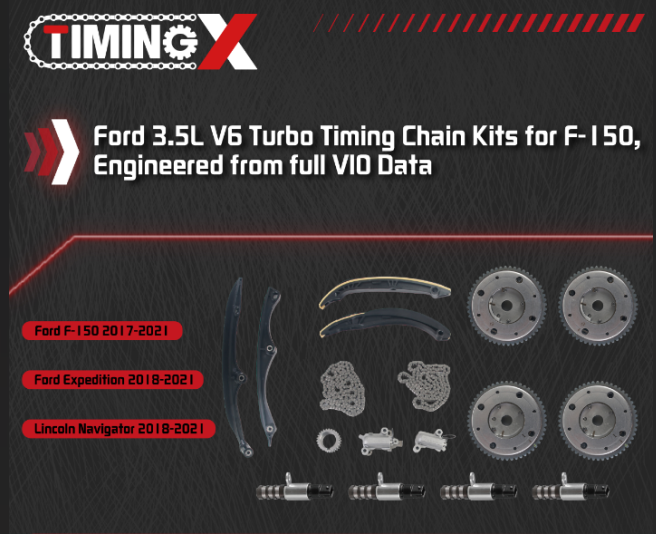
Ningbo Motor Auto Parts, a multifaceted auto parts provider specializing in engine products and drive systems, is expanding its timing chain kit line with 13 part numbers to cover another tens of thousands vehicles in operation. All of the new part numbers are already available now.
Ningbo Motor Auto Parts’ timing chain kit team launched the line in 2018 due to the car park shift from timing belts to timing chains at the OE level and Launched the innovative brand “TIMING-X” in 2022. The kits, which feature OE-quality components, cover high-volume light-duty engine applications. They include all the necessary components for a thorough and complete repair, building on Ningbo Motor Auto Parts’ mission of recommending system replacement as a best practice.
The kits include:
Exceptional Timing and Durable Chains: Our kits feature superior timing and robust secondary chains designed to resist stretching throughout their lifespan, tackling the primary concern in replacements.
Quiet, Precision Performance: The kit includes precision-machined cam and crank sprockets that ensure a silent, smooth operation.
High-Quality, Direct Fit Components: Comes with OE-quality high-grade plastic guides, along with VVT solenoids and cam phasers where required for a perfect fit.
Ningbo Motor Auto Parts backs its entire timing chain kit line with an industry-leading 3 year or 80,000 mile parts warranty
It was the 25th anniversary annual meeting of Ningbo Motor Auto Parts, attended by the entire company, valued partners, and suppliers.Our customers from around the world sent video messages that were showcased during the meeting.

The business units for turbochargers, timing chains, suspension and steering, alloy wheels, car accessories, and motorcycle parts put on impressive performances with singing and dancing. Celebrating 25 years has given us the confidence to deepen our roots in the industry, looking forward to another 75 years to become a leading company in the auto parts sector.




As the festive bells of Christmas draw near, all of us at Ningbo Motor company would like to extend our warmest greetings and heartfelt gratitude to you. This season is not only a time for celebration but also a moment to reflect on the wonderful journey we’ve shared throughout the year.
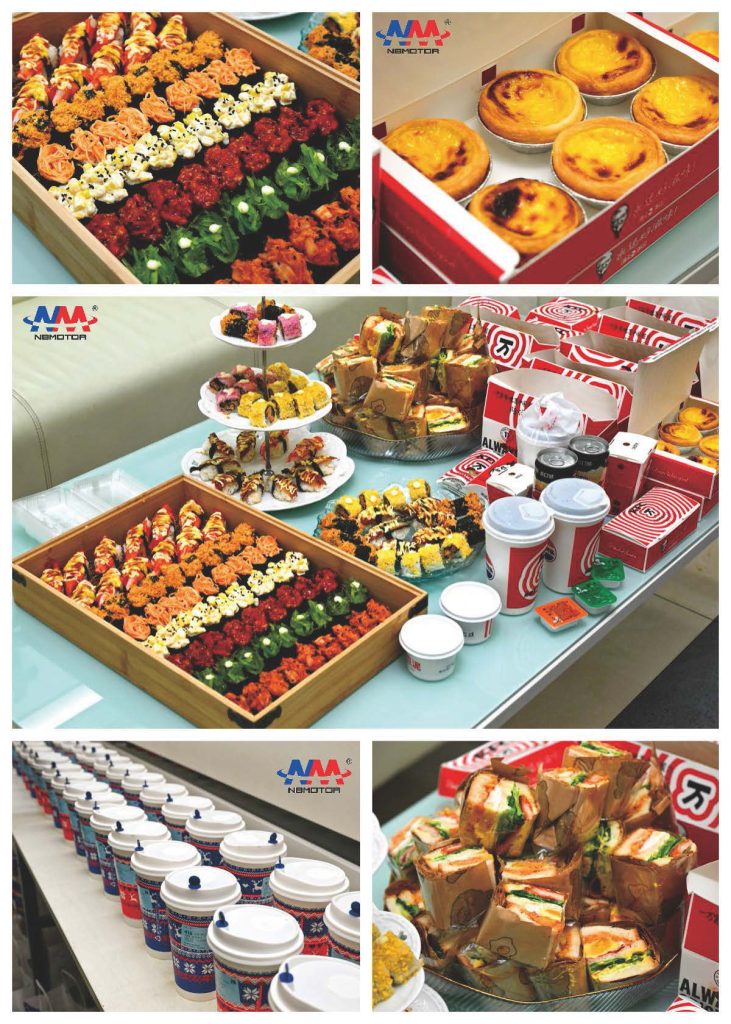
Happy Thanksgiving, NBMOTOR Company! May this Thanksgiving bring you joy, prosperity, and a time to reflect on all the blessings and achievements. We are truly grateful for our association with you and look forward to continued success together in the days to come. Best regards!
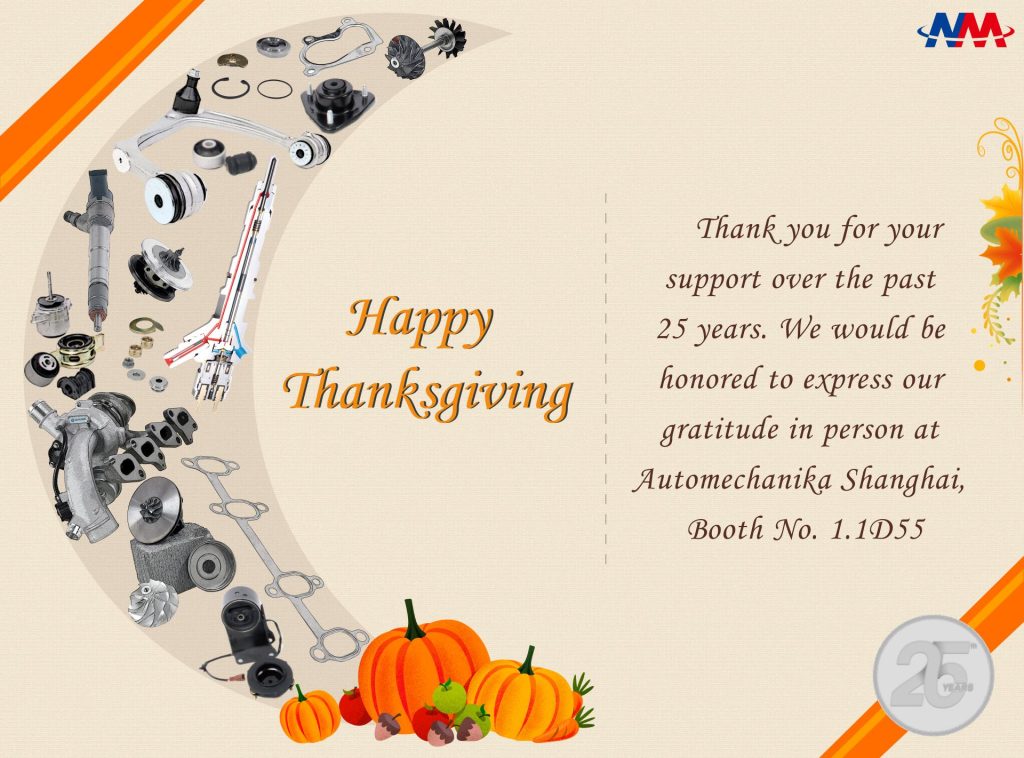
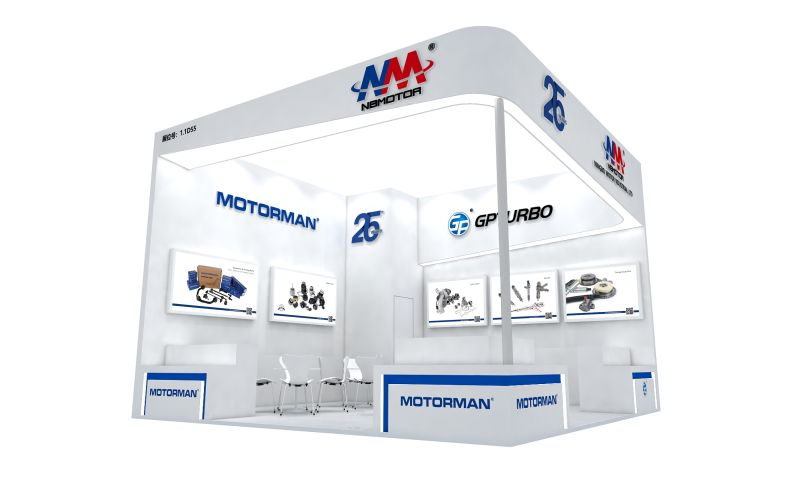
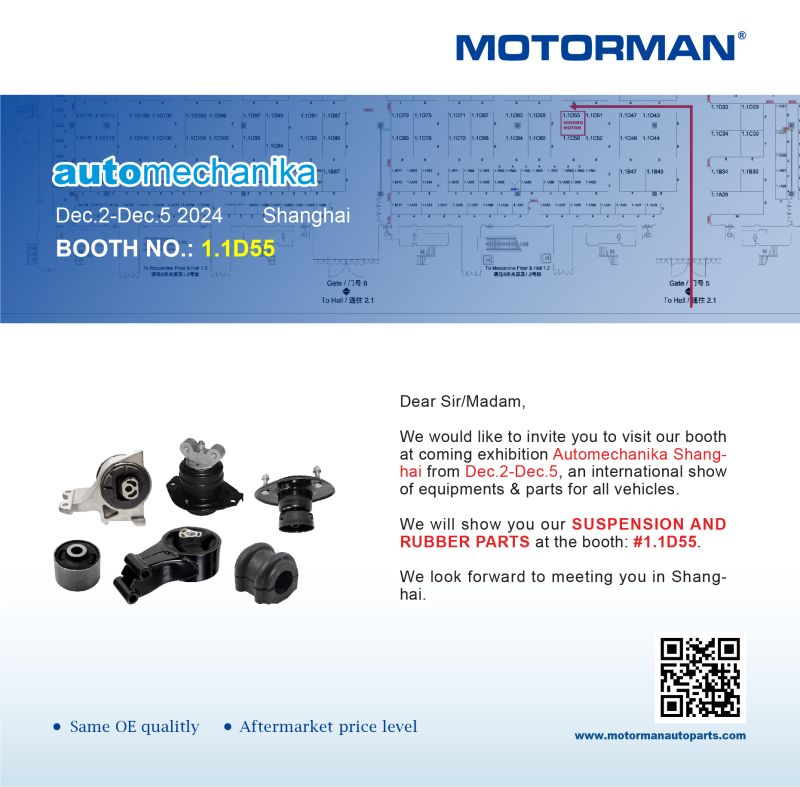
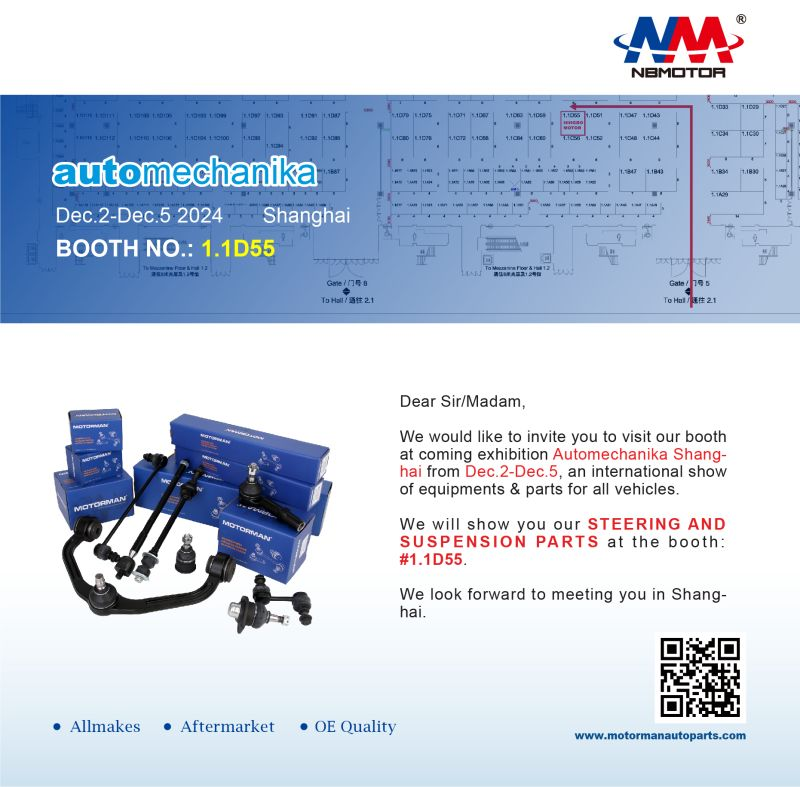
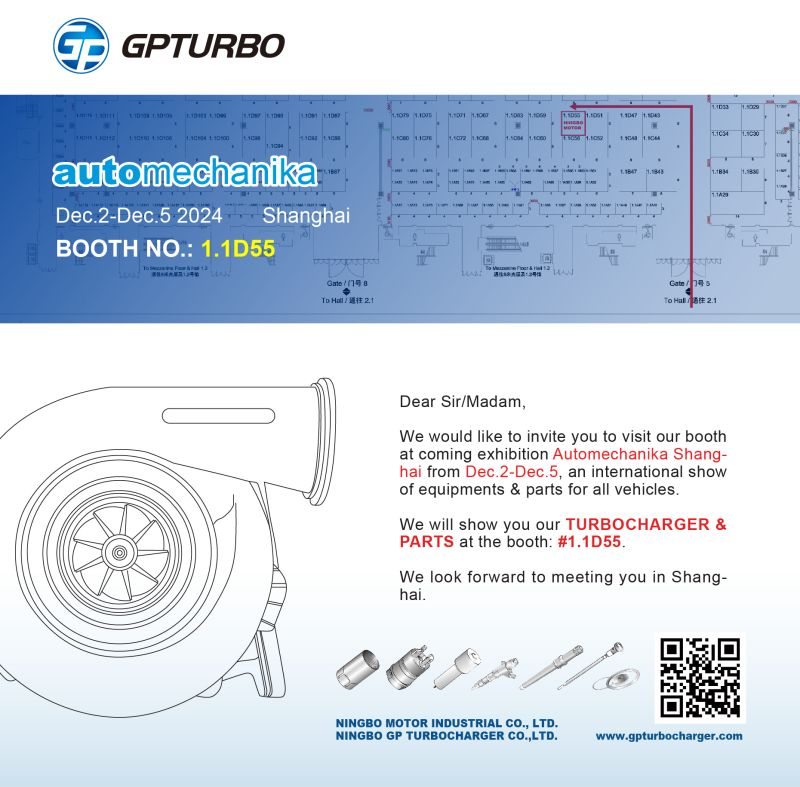
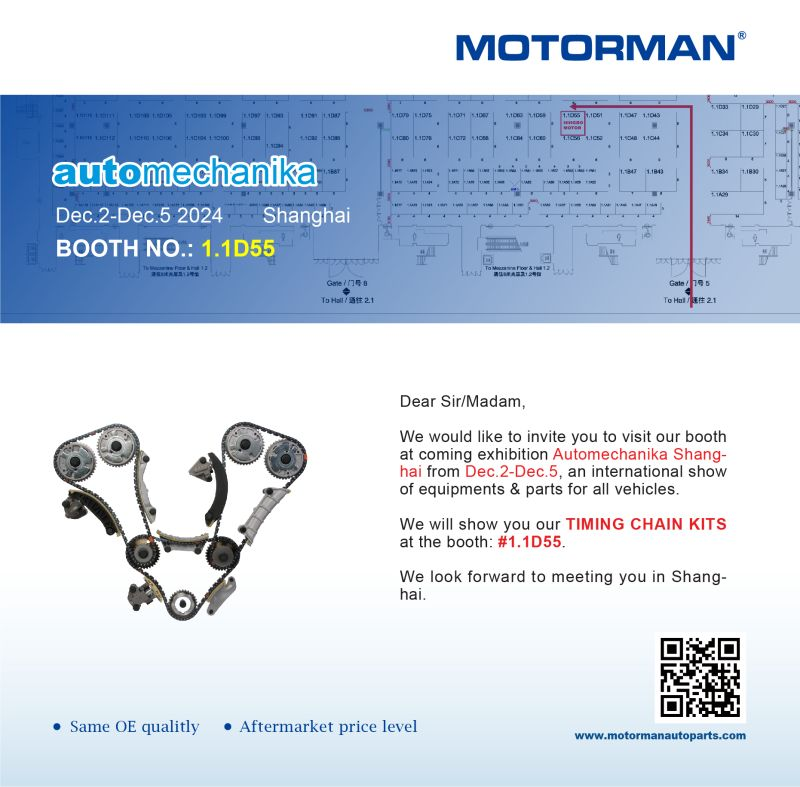
Shanghai automechanika period comes! Meet us to explore more of #timngchains #chassis #steering #suspension #turbochargers #rubberparts at booth 1.1D55
https://www.linkedin.com/feed/update/urn:li:activity:7264198381323857921